English · 1890
The Darby Bible
J.N. Darby’s New Translation is an English Bible translated closely from the Hebrew and Greek, first published complete in 1890. Here is what makes it different from the King James Version, in Darby’s own words.
What is the Darby Bible?
The Darby Bible is the translation made by John Nelson Darby (1800–1882), an Anglo-Irish clergyman who left the Church of Ireland. He also worked on translations into German and French.
His English New Testament came first, in 1867. He died in 1882 before the Old Testament was finished, and it was completed from his work after his death. The whole Bible appeared in 1890. It has all 66 books, Genesis to Revelation, and it is in the public domain.
How it differs from the King James Version
Darby kept the older forms the King James Version uses, such as “thou” and “thy”, but he set out to show the original text more exactly. Four differences stand out.
God’s name is written out
Where the King James Version usually writes “the LORD”, Darby writes the Hebrew name, Jehovah. It appears in more than 5,700 verses.
Jehovah is my shepherd; I shall not want.
Psalm 23:1
He also marks two other Hebrew words for God. A raised dot stands for El and a dagger for Eloah, so the reader can tell them from the usual word, Elohim.
Jehovah is my rock, and my fortress, and my deliverer; my ·God, my rock, in whom I will trust; my shield, and the horn of my salvation, my high tower.
Psalm 18:2
That day—let it be darkness; let not †God care for it from above, neither let light shine upon it:
Job 3:4
Added words are in square brackets
Every translation has to add small words that English needs. The King James Version prints them in italics. Darby puts them in square brackets, so you can see exactly what is in the original. His italics mark emphasis instead.
In [the] beginning was the Word, and the Word was with God, and the Word was God.
John 1:1
Words chosen for exactness
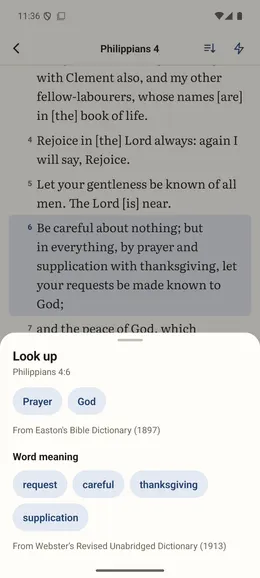
Darby often picks a less familiar word because it is closer to the Greek. Some of his words have also changed meaning since 1890: “careful” meant anxious, full of care.
Put on the panoply of God, that ye may be able to stand against the artifices of the devil:
Ephesians 6:11
Love has long patience, is kind; love is not emulous [of others]; love is not insolent and rash, is not puffed up,
1 Corinthians 13:4
Be careful about nothing; but in everything, by prayer and supplication with thanksgiving, let your requests be made known to God;
Philippians 4:6
Three verses are left out
Matthew 23:14, Acts 8:37 and Acts 15:34 are in the King James Version but not in Darby’s. They are missing from many of the oldest Greek manuscripts, and Darby did not include them. The verse numbers stay, so references still line up.
Is the Darby Bible accurate?
Darby’s aim was to follow the Hebrew and Greek as closely as English allows, even where that reads less smoothly. The square brackets, the written-out name of God and the marks for El and Eloah all let the reader see the original more clearly. That makes it a careful translation to study from. The cost is that some sentences read stiffly, and a few words need explaining today.
Reading plans in the Darby Bible
Darby’s Bible is 775,647 words. Read every day for a year, that’s about 11 minutes a day. You can make your own plan, read it in the order events happened, or see how long each plan takes.
Reading the Darby Bible today
Ribbon is a Darby Bible app for Android phones. It has the whole of Darby’s 1890 translation, and it puts a daily reading plan into the page you read. Select a verse and tap Look up to see what Darby’s words mean, including old senses such as “careful”.